Thursday, October 23, 2008


Thomas Jefferson had it right!
"I believe that banking institutions are more dangerous to our liberties than standing armies. If the American people ever allow private banks to control the issue of their currency, first by inflation, then by deflation, the banks and corporations that will grow up around the banks will deprive the people of all property until their children wake-up homeless on the continent their fathers conquered." Thomas Jefferson - Letter to the Secretary of the Treasury Albert Gallatin (1802), 3rd president of US (1743 - 1826)
On Fannie and Freddie:
Congressional Hearing about Fannie and Freddie
Here's Barney Frank's opinion of how we got there:
Barney Frank passes the blame
On Fannie and Freddie:
Congressional Hearing about Fannie and Freddie
Here's Barney Frank's opinion of how we got there:
Barney Frank passes the blame
The Federal Bailout Continues and Expands
U.S. Agriculture Secretary Ed Schafer said the federal government is considering outlays of as much as $25 million to help ethanol plants, which have been hit by volatile commodity prices:
http://www.bizjournals.com/phoenix/stories/2008/10/20/daily45.html?ana=from_rss
FDIC Chaiman Shiela Bair Senate Banking Chairman Christopher Dodd urges the Treasury to use its new authority to spur servicers to modify loans. "This slender provision alone can help countless deserving Americans escape the foreclosure trap set by predatory lenders," Sen. Dodd said in prepared remarks. FDIC Chairman Sheila Bair testified before the banking committe and stated "Specifically, the government could establish standards for loan modifications and provide guarantees for loans meeting those standards.............by doing so, unaffordable loans could be converted into loans that are sustainable over the long term."
http://www.fdic.gov/news/news/speeches/chairman/spoct2308.html
http://www.bizjournals.com/phoenix/stories/2008/10/20/daily45.html?ana=from_rss
FDIC Chaiman Shiela Bair Senate Banking Chairman Christopher Dodd urges the Treasury to use its new authority to spur servicers to modify loans. "This slender provision alone can help countless deserving Americans escape the foreclosure trap set by predatory lenders," Sen. Dodd said in prepared remarks. FDIC Chairman Sheila Bair testified before the banking committe and stated "Specifically, the government could establish standards for loan modifications and provide guarantees for loans meeting those standards.............by doing so, unaffordable loans could be converted into loans that are sustainable over the long term."
http://www.fdic.gov/news/news/speeches/chairman/spoct2308.html
Wednesday, October 22, 2008
Morgan Stanley's Bonuses Get Saved By You and Me
http://www.bloomberg.com/apps/news?pid=20601039&sid=azo7aySdpFHw&refer=home
This from Jonathan Weil on the Bloomberg website:
"You can imagine the devilish grins on the faces of Morgan Stanley employees last week, after the Treasury Department said it would pump $10 billion into the bank. Not only did we, the taxpayers, save their company, with the help of a Japanese bank named Mitsubishi UFJ Financial Group Inc. More importantly, we funded their 2008 bonus pool."
Mr. Weil goes on to say: "Here's all you really need to know to see who lost and who benefited most at the Five Families of Wall Street, otherwise known as Goldman, Morgan Stanley, Merrill Lynch, Lehman Brothers and Bear Stearns. From the start of their 2004 fiscal years through yesterday, the big standalone investment banks lost about $83 billion of stock-market value. During the same period, they reported about $239 billion of employee-compensation expense........So, for every dollar of shareholder value destroyed, the employees got paid almost three. "
This from Jonathan Weil on the Bloomberg website:
"You can imagine the devilish grins on the faces of Morgan Stanley employees last week, after the Treasury Department said it would pump $10 billion into the bank. Not only did we, the taxpayers, save their company, with the help of a Japanese bank named Mitsubishi UFJ Financial Group Inc. More importantly, we funded their 2008 bonus pool."
Mr. Weil goes on to say: "Here's all you really need to know to see who lost and who benefited most at the Five Families of Wall Street, otherwise known as Goldman, Morgan Stanley, Merrill Lynch, Lehman Brothers and Bear Stearns. From the start of their 2004 fiscal years through yesterday, the big standalone investment banks lost about $83 billion of stock-market value. During the same period, they reported about $239 billion of employee-compensation expense........So, for every dollar of shareholder value destroyed, the employees got paid almost three. "
Cramer and his "Too little too late" advice
On October 6, CNBC "stock market analyst" Jim Cramer was appearing on NBC's Today Show.
The Dow had been rapidly dropping, had passed 10,000 and was continuing downward. It was now about 33% off it's high of about 14,000 which had been set a year earlier.
Cramer, ever the stock guru, offered this investment advice to the viewers of the show: "Whatever you may need for the next five years, please take it out of the stock market. Right now. This week. I do not believe that you should risk those assets in the stock market." Cramer said that his advice was prompted by the concern that "We could have as much as a 20% decline in the stock market." He went on to say "If you can withstand this, just ride it out."
(Update October 23: The Dow is down 16.21% since October 6; it seems Jim Cramer may have been too optimistic!)
Here is the interview: http://www.youtube.com/watch?v=uoSLVCEGKko
That was good advice. However, it was already a bit too late to offer it. It is recommended by most financial consultants that one shoud NEVER put money that is needed within 5 years into the stock market. And, if one is nearing or in retirement, that money shouldn't be put at risk. Money invested in the market is at risk.
So here we are. Thanks Jim Cramer. Any retirees watching your show "Mad Money" and playing the game, day after day, could possible have lost 1/3 to 1/2 of their retirement assets, before pulling the plug on your advice and then contributing to the "panic".
I suppose I could be criticized for lambasting Cramer. But I think my anger toward him, and others like him, is justified. No, I don't follow his advice. I do watch his show occasionally while using the tread mill at the gym. It strikes me that his show could be called "Having Fun and the Lure of Making Money through Trading". However, there is risk in the stock market and many people who had been lulled into complacency by the likes of Cramer have suddenly re-awoken to that risk. And when they did, they yanked all of their money out of stock, bonds, even gold!
The truth is, the only people guaranteed to make money in the stock market are stock brokers, who make a commission on every sale, and media types such as Cramer, who get paid very well to entice the lemmings to the cliff. There are those who say all of this is for the good of the "service economy".
Those of us who are "invested" are taking risks. True, over the long term, there is ample evidence that it is possible to make money buying quality stocks. Cramer is now advocating just that. He said yesterday (October 21) on his program that "It's still possible to make money in stocks... It's always been possible. But you have to know what to look for, particularly in this market!... As much as this market has made us lose some of our faith in the ability of stocks to go higher... As much as this market has pummeled us beyond all recognition... it's also given us a new touchstone... it has given us... a new faith in dividends..."
The title of that program, as per his website, was:
"Stick with the Dividend Plays for Capital Preservation..."
http://www.madmoneyrecap.com/index.html
So now Cramer says, take what is left of your retirement portfolio and put it into dividend paying stocks! Of course, there are stocks out there that pay dividends, healthy dividends, but won't survive the economic downturn. Oh, and by the way, if you get a healthy 5% growth on your remaining investments, and assuming you lost 40% in the past year, it could take 10 years using this investing technique to get back to where you were in September 2007! If you do very well and can get 10% growth on your ravaged portfolio, it will only take 6 years to recover. Which is why having a stock market time horizon of less than 5 to 10 years is dangerous to your financial health. It is I suppose why Jim Cramer told people to pull their money. However, there is frequently a sharp upswing in the market at the conclusion of a bear market. For example, at the conclusion of the bear markets of 1974 and 1982, which were very severe bear markets, the stock market returned at least 60% in the next 9 months. I have read that this also happened after the 1932 stock market bottom which was the Great Depression.
See this website: Bear Market Recoveries Since 1950
In the above, you will note that it took 10 years for the S&P 500 to fully recover. This was considered a worst case scenario. The important thing is to realize that these long, anemic or sideways markets do and did happen. Can you wait 10 years?
In fairness to Cramer, there is money to be made in trading stocks, and a lot of people have fun doing some trading. I suppose it's a healthy pastime, as long as one doesn't jeopardize their retirement funds. That means, probably no more than about 5% of one's worth should ever be invested for trading on a show such as Cramer's. If you "win" fine, and if you lose it all, you haven't lost much. But it is easy to get cocky and it is easy to get caught up in the excitement. People do it each and every day in casinos all across the USA.
You are probably wondering if I am invested in the stock market. The answer is yes. I do have my reasons. If you want to know what they are, then go to this site: http://letmethinkaboutthis.blogspot.com/2008/10/check-in-in-20-years.html
The Dow had been rapidly dropping, had passed 10,000 and was continuing downward. It was now about 33% off it's high of about 14,000 which had been set a year earlier.
Cramer, ever the stock guru, offered this investment advice to the viewers of the show: "Whatever you may need for the next five years, please take it out of the stock market. Right now. This week. I do not believe that you should risk those assets in the stock market." Cramer said that his advice was prompted by the concern that "We could have as much as a 20% decline in the stock market." He went on to say "If you can withstand this, just ride it out."
(Update October 23: The Dow is down 16.21% since October 6; it seems Jim Cramer may have been too optimistic!)
Here is the interview: http://www.youtube.com/watch?v=uoSLVCEGKko
That was good advice. However, it was already a bit too late to offer it. It is recommended by most financial consultants that one shoud NEVER put money that is needed within 5 years into the stock market. And, if one is nearing or in retirement, that money shouldn't be put at risk. Money invested in the market is at risk.
So here we are. Thanks Jim Cramer. Any retirees watching your show "Mad Money" and playing the game, day after day, could possible have lost 1/3 to 1/2 of their retirement assets, before pulling the plug on your advice and then contributing to the "panic".
I suppose I could be criticized for lambasting Cramer. But I think my anger toward him, and others like him, is justified. No, I don't follow his advice. I do watch his show occasionally while using the tread mill at the gym. It strikes me that his show could be called "Having Fun and the Lure of Making Money through Trading". However, there is risk in the stock market and many people who had been lulled into complacency by the likes of Cramer have suddenly re-awoken to that risk. And when they did, they yanked all of their money out of stock, bonds, even gold!
The truth is, the only people guaranteed to make money in the stock market are stock brokers, who make a commission on every sale, and media types such as Cramer, who get paid very well to entice the lemmings to the cliff. There are those who say all of this is for the good of the "service economy".
Those of us who are "invested" are taking risks. True, over the long term, there is ample evidence that it is possible to make money buying quality stocks. Cramer is now advocating just that. He said yesterday (October 21) on his program that "It's still possible to make money in stocks... It's always been possible. But you have to know what to look for, particularly in this market!... As much as this market has made us lose some of our faith in the ability of stocks to go higher... As much as this market has pummeled us beyond all recognition... it's also given us a new touchstone... it has given us... a new faith in dividends..."
The title of that program, as per his website, was:
"Stick with the Dividend Plays for Capital Preservation..."
http://www.madmoneyrecap.com/index.html
So now Cramer says, take what is left of your retirement portfolio and put it into dividend paying stocks! Of course, there are stocks out there that pay dividends, healthy dividends, but won't survive the economic downturn. Oh, and by the way, if you get a healthy 5% growth on your remaining investments, and assuming you lost 40% in the past year, it could take 10 years using this investing technique to get back to where you were in September 2007! If you do very well and can get 10% growth on your ravaged portfolio, it will only take 6 years to recover. Which is why having a stock market time horizon of less than 5 to 10 years is dangerous to your financial health. It is I suppose why Jim Cramer told people to pull their money. However, there is frequently a sharp upswing in the market at the conclusion of a bear market. For example, at the conclusion of the bear markets of 1974 and 1982, which were very severe bear markets, the stock market returned at least 60% in the next 9 months. I have read that this also happened after the 1932 stock market bottom which was the Great Depression.
See this website: Bear Market Recoveries Since 1950
In the above, you will note that it took 10 years for the S&P 500 to fully recover. This was considered a worst case scenario. The important thing is to realize that these long, anemic or sideways markets do and did happen. Can you wait 10 years?
In fairness to Cramer, there is money to be made in trading stocks, and a lot of people have fun doing some trading. I suppose it's a healthy pastime, as long as one doesn't jeopardize their retirement funds. That means, probably no more than about 5% of one's worth should ever be invested for trading on a show such as Cramer's. If you "win" fine, and if you lose it all, you haven't lost much. But it is easy to get cocky and it is easy to get caught up in the excitement. People do it each and every day in casinos all across the USA.
You are probably wondering if I am invested in the stock market. The answer is yes. I do have my reasons. If you want to know what they are, then go to this site: http://letmethinkaboutthis.blogspot.com/2008/10/check-in-in-20-years.html
Tuesday, October 21, 2008
Warren Buffett Says "Buy American, I am!"
Warren Buffett wrote and Op-Ed piece in the New York Times last week. On first blush, it sounds good. See:
http://www.nytimes.com/2008/10/17/opinion/17buffett.html?em
To Quote Mr Buffett:
"The financial world is a mess, both in the United States and abroad. Its problems, moreover, have been leaking into the general economy, and the leaks are now turning into a gusher. In the near term, unemployment will rise, business activity will falter and headlines will continue to be scary.
So ... I’ve been buying American stocks. This is my personal account I’m talking about, in which I previously owned nothing but United States government bonds. If prices keep looking attractive, my non-Berkshire net worth will soon be 100 percent in United States equities...."
Mr. Buffett goes on to say:
"Today people who hold cash equivalents feel comfortable. They shouldn’t. They have opted for a terrible long-term asset, one that pays virtually nothing and is certain to depreciate in value. Indeed, the policies that government will follow in its efforts to alleviate the current crisis will probably prove inflationary and therefore accelerate declines in the real value of cash accounts.
Equities will almost certainly outperform cash over the next decade, probably by a substantial degree. Those investors who cling now to cash are betting they can efficiently time their move away from it later. In waiting for the comfort of good news, they are ignoring Wayne Gretzky’s advice: “I skate to where the puck is going to be, not to where it has been.”"
This sounds good, and Mr. Buffett did purchase a stake in GE to the tune of $3 Billion, and before that in Goldman Sachs. Unfortunately, his investment is not in the same common stock I would be purchasing if I were to "Buy American". Mr. Buffett is getting the best equity investment possible via preferred stock, and in the case of GE, is also getting a 10% annual dividend. GE can buy the stock back after three years, but only at a 10% premium. Mr. Buffett also gets warrants to buy GE common stock at any time during the next five years at $22.25 a share. Keep in mind that one year ago, GE common stock was selling for $40 a share. If the stock recovers, Mr. Buffett could double his return on top of the dividends he is getting paid.
However, I will get no such deal if I "Buy American". Something to keep in mind when reading Mr. Buffett's piece.
In fairness to Mr. Buffett, he is stating that stocks at the moment are "cheap". Deal or no deal, the price is right! He also says that "If prices keep looking attractive, my non-Berkshire net worth will soon be 100 percent in United States equities."
Sounds good to me! In fact, when the market tanked, I stopped everything and made a list of stocks in various companies I want to own, and had not previously purchased as I felt the stock was overpriced. I have since used that list to purchase stock in one company; I do expect to purchase stock from the other companies on my list and perhaps for all of those on my list.
http://www.nytimes.com/2008/10/17/opinion/17buffett.html?em
To Quote Mr Buffett:
"The financial world is a mess, both in the United States and abroad. Its problems, moreover, have been leaking into the general economy, and the leaks are now turning into a gusher. In the near term, unemployment will rise, business activity will falter and headlines will continue to be scary.
So ... I’ve been buying American stocks. This is my personal account I’m talking about, in which I previously owned nothing but United States government bonds. If prices keep looking attractive, my non-Berkshire net worth will soon be 100 percent in United States equities...."
Mr. Buffett goes on to say:
"Today people who hold cash equivalents feel comfortable. They shouldn’t. They have opted for a terrible long-term asset, one that pays virtually nothing and is certain to depreciate in value. Indeed, the policies that government will follow in its efforts to alleviate the current crisis will probably prove inflationary and therefore accelerate declines in the real value of cash accounts.
Equities will almost certainly outperform cash over the next decade, probably by a substantial degree. Those investors who cling now to cash are betting they can efficiently time their move away from it later. In waiting for the comfort of good news, they are ignoring Wayne Gretzky’s advice: “I skate to where the puck is going to be, not to where it has been.”"
This sounds good, and Mr. Buffett did purchase a stake in GE to the tune of $3 Billion, and before that in Goldman Sachs. Unfortunately, his investment is not in the same common stock I would be purchasing if I were to "Buy American". Mr. Buffett is getting the best equity investment possible via preferred stock, and in the case of GE, is also getting a 10% annual dividend. GE can buy the stock back after three years, but only at a 10% premium. Mr. Buffett also gets warrants to buy GE common stock at any time during the next five years at $22.25 a share. Keep in mind that one year ago, GE common stock was selling for $40 a share. If the stock recovers, Mr. Buffett could double his return on top of the dividends he is getting paid.
However, I will get no such deal if I "Buy American". Something to keep in mind when reading Mr. Buffett's piece.
In fairness to Mr. Buffett, he is stating that stocks at the moment are "cheap". Deal or no deal, the price is right! He also says that "If prices keep looking attractive, my non-Berkshire net worth will soon be 100 percent in United States equities."
Sounds good to me! In fact, when the market tanked, I stopped everything and made a list of stocks in various companies I want to own, and had not previously purchased as I felt the stock was overpriced. I have since used that list to purchase stock in one company; I do expect to purchase stock from the other companies on my list and perhaps for all of those on my list.
Mark Zandi on the Risky Loans Behind the Meltdown
"'Financial Shock': Mark Zandi on the Risky Loans Behind the Meltdown"
http://knowledge.wharton.upenn.edu/article.cfm?articleid=2076
Mark Zandi is chief economist, and founder of Moody's Economy.com. Moody's is one of the rating agencies that has been reported as dropping the ball in the recent financial meltdown, rating sophisticated mortgaged backed securities as AAA, or as good as U.S. Treasury bills and bonds. Mr. Zandi is in the process of publishing a book "Financial Shock" which is about the entire mess. Here is a quote from the above article:
"Well, many things surprised me. But at the most fundamental level, it was just how egregious the lending had become at the peak of the housing boom. It wasn't just simply making loans to people with low credit scores. It was making loans to people with low credit scores with no down payment, or down payment assistance. With no proof of income and just an enormous amount of risk layering that was going on. You know, I had a sense that obviously underwriting standards in the mortgage industry had fallen. I had no concept to what degree they had declined. And that's a bit surprising to me, because many of my clients are in the industry. They're mortgage companies, mortgage insurance companies; the Fannie Maes and Freddie Macs of the world. And I thought I had a pretty good understanding. I thought it was bad, but I had no understanding of how bad it really was."
Mr. Zandi closed the interview with this comment: "We still don't know -- really don't know -- how many people are being foreclosed on. No one knows. And that's not the fodder of good policy-making."
For some idea of what the foreclosure rate will look like for the near term (2008 to 2012) go to this link, which shows the anticipated increases in mortgage interest rate resets, or increases. Foreclosures will rise as these mortgages reset. The chart isn't pretty:
http://www.goodevalue.com/wp-content/uploads/2008/04/imfresets.jpg
As for Mr. Zandi's comment about the numbers of people being foreclosed on, consider this. It is anticipated that many option-ARM borrowers will face significantly higher monthly payment increases in the near future. How many? The statistics I have seen indicate that loans totaling about $30 billion will reset in 2009 and as much at $70 billion will reset in 2010. These are not sub-prime loans.
As a result, defaults are expected to double again. I think that politicians or economists who expect the housing market crises will “bottom” in early 2009 are absolutely wrong, unless there is strong government intervention to prevent these automatic resets. This event is not a surprise. In March 2008, Goldman Sachs estimated that a 15% decline in housing values would occur and that 21% of the total number of people with a mortgage would owe more than their house was worth. However, it was also estimated that if a recession occurred then there would be a total decline in the value of housing of 30% and a whopping 39% of people owing mortgages would be under water. It is now a certainty that we are in or are entering a serious recession.
I am not certain if our government will intervene until it is too late. At present, congress is working on committees of lynching parties rather than averting this looming crisis. So batten down the hatches and be prepared for a potentially rough ride for the next two or three years. However, the pessimists say it will be 2020 before all of this gets straightened out!
For more on the mortgage resets, go to:
http://letmethinkaboutthis.blogspot.com/2008/10/is-it-greed-or-stupidity.html
http://knowledge.wharton.upenn.edu/article.cfm?articleid=2076
Mark Zandi is chief economist, and founder of Moody's Economy.com. Moody's is one of the rating agencies that has been reported as dropping the ball in the recent financial meltdown, rating sophisticated mortgaged backed securities as AAA, or as good as U.S. Treasury bills and bonds. Mr. Zandi is in the process of publishing a book "Financial Shock" which is about the entire mess. Here is a quote from the above article:
"Well, many things surprised me. But at the most fundamental level, it was just how egregious the lending had become at the peak of the housing boom. It wasn't just simply making loans to people with low credit scores. It was making loans to people with low credit scores with no down payment, or down payment assistance. With no proof of income and just an enormous amount of risk layering that was going on. You know, I had a sense that obviously underwriting standards in the mortgage industry had fallen. I had no concept to what degree they had declined. And that's a bit surprising to me, because many of my clients are in the industry. They're mortgage companies, mortgage insurance companies; the Fannie Maes and Freddie Macs of the world. And I thought I had a pretty good understanding. I thought it was bad, but I had no understanding of how bad it really was."
Mr. Zandi closed the interview with this comment: "We still don't know -- really don't know -- how many people are being foreclosed on. No one knows. And that's not the fodder of good policy-making."
For some idea of what the foreclosure rate will look like for the near term (2008 to 2012) go to this link, which shows the anticipated increases in mortgage interest rate resets, or increases. Foreclosures will rise as these mortgages reset. The chart isn't pretty:
http://www.goodevalue.com/wp-content/uploads/2008/04/imfresets.jpg
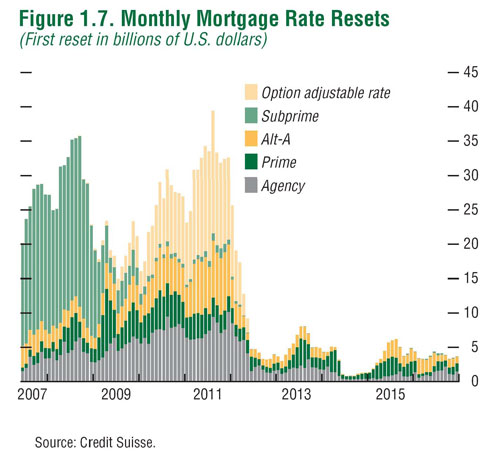
As for Mr. Zandi's comment about the numbers of people being foreclosed on, consider this. It is anticipated that many option-ARM borrowers will face significantly higher monthly payment increases in the near future. How many? The statistics I have seen indicate that loans totaling about $30 billion will reset in 2009 and as much at $70 billion will reset in 2010. These are not sub-prime loans.
As a result, defaults are expected to double again. I think that politicians or economists who expect the housing market crises will “bottom” in early 2009 are absolutely wrong, unless there is strong government intervention to prevent these automatic resets. This event is not a surprise. In March 2008, Goldman Sachs estimated that a 15% decline in housing values would occur and that 21% of the total number of people with a mortgage would owe more than their house was worth. However, it was also estimated that if a recession occurred then there would be a total decline in the value of housing of 30% and a whopping 39% of people owing mortgages would be under water. It is now a certainty that we are in or are entering a serious recession.
I am not certain if our government will intervene until it is too late. At present, congress is working on committees of lynching parties rather than averting this looming crisis. So batten down the hatches and be prepared for a potentially rough ride for the next two or three years. However, the pessimists say it will be 2020 before all of this gets straightened out!
For more on the mortgage resets, go to:
http://letmethinkaboutthis.blogspot.com/2008/10/is-it-greed-or-stupidity.html
Subscribe to:
Posts (Atom)