If anyone was wondering, I haven't gone away!
I've been catching up on "business" and dealing with issues out there in the "real" world.
I also wanted to give the economy and our new congress and President some time to allow the "dust to settle". There has been more info available in the popular press than has been possible to digest, and it does take some time to establish new "programs".
Bailout of banks, bankers and investment houses continue, but homeowners, the source of the problem, have seen little assistance or relief. So mortgage defaults continue.
I am not entering the debate about whom deserves or doesn't deserve government bailout money. It is apparent that a lot of people were greedy, a lot of people made mistakes or were simply stupid, and a lot of people perpetrated various frauds. The question I have is, where and how is the best way to spend this money. It will and is being spent, afterall.
I am looking at this from the perspective of spending as little as possible to resolve the problem. We have about 7.3 million homeowners who have defaulted or are at risk of default. If these people were given a stipend by the government which was applied against their mortgages, this money would be passed to the banks who would be forced to lower the balance on their mortgages, it would find its way to those who hold the notes, etc. and should stabilize the system.
But how much money would it take? Or, how far could a trillion dollars, which is the amount routinely used as fodder for the pigs at the toughs, go? I'll round up the number of mortgages to 10 million. Well, one Trillion dollars = $1,000,000,000,000. If I were to divide that by 10 million distressed mortgages (10,000,000) I would have $100,000 per mortgage.
So which has been more effective? Throwing several trillion dollars at the banks and investmenr bankers, or throwing $50,000 at each distressed homeowner? We could bail out 10 million homeowners and the entire banking system directly tied to these failed mortgages, using "only" one-half trillion dollars, which is $500 billion.
So now you know why am so cynical about our politicians. They could get the job done and they should know what I know. But they don't operate accordingly. So looking beyond all the rhetoric of the politicians and their media pundits, who is really being served? I'll let you draw your own conclusions.
Note: one trillion is a really big number. How big? Let's do a little arithmetic and answer the question "how many seconds is a trillion?" There are 365 days each year, 24 hours each day, 60 minutes each hour and 60 seconds each minute. So a year is 365 x 24 x 60 x 60 seconds = 31,536,000 seconds. If I divide 1 trillion by the number of seconds in a year, I'll know how many years contain 1 trillion seconds. The answer is 31,709 years.
Showing posts with label $700 Billion Bailout. Show all posts
Showing posts with label $700 Billion Bailout. Show all posts
Wednesday, March 11, 2009


Wednesday, November 19, 2008
A Quote from a Banker
Mr. Kenneth Lewis, CEO of the Bank of America, which only 3 weeks ago got $15 billion from the federal government as part of the massive bailout of the banks, was quoted yesterday commenting on the automotive industry's request for a bailout of their own. The "Big Three [automakers] is one too many.....[and] the American people aren’t interested in just giving more money and not helping them change.”
Interesting!
Interesting!
Thursday, October 23, 2008
Thomas Jefferson had it right!
"I believe that banking institutions are more dangerous to our liberties than standing armies. If the American people ever allow private banks to control the issue of their currency, first by inflation, then by deflation, the banks and corporations that will grow up around the banks will deprive the people of all property until their children wake-up homeless on the continent their fathers conquered." Thomas Jefferson - Letter to the Secretary of the Treasury Albert Gallatin (1802), 3rd president of US (1743 - 1826)
On Fannie and Freddie:
Congressional Hearing about Fannie and Freddie
Here's Barney Frank's opinion of how we got there:
Barney Frank passes the blame
On Fannie and Freddie:
Congressional Hearing about Fannie and Freddie
Here's Barney Frank's opinion of how we got there:
Barney Frank passes the blame
The Federal Bailout Continues and Expands
U.S. Agriculture Secretary Ed Schafer said the federal government is considering outlays of as much as $25 million to help ethanol plants, which have been hit by volatile commodity prices:
http://www.bizjournals.com/phoenix/stories/2008/10/20/daily45.html?ana=from_rss
FDIC Chaiman Shiela Bair Senate Banking Chairman Christopher Dodd urges the Treasury to use its new authority to spur servicers to modify loans. "This slender provision alone can help countless deserving Americans escape the foreclosure trap set by predatory lenders," Sen. Dodd said in prepared remarks. FDIC Chairman Sheila Bair testified before the banking committe and stated "Specifically, the government could establish standards for loan modifications and provide guarantees for loans meeting those standards.............by doing so, unaffordable loans could be converted into loans that are sustainable over the long term."
http://www.fdic.gov/news/news/speeches/chairman/spoct2308.html
http://www.bizjournals.com/phoenix/stories/2008/10/20/daily45.html?ana=from_rss
FDIC Chaiman Shiela Bair Senate Banking Chairman Christopher Dodd urges the Treasury to use its new authority to spur servicers to modify loans. "This slender provision alone can help countless deserving Americans escape the foreclosure trap set by predatory lenders," Sen. Dodd said in prepared remarks. FDIC Chairman Sheila Bair testified before the banking committe and stated "Specifically, the government could establish standards for loan modifications and provide guarantees for loans meeting those standards.............by doing so, unaffordable loans could be converted into loans that are sustainable over the long term."
http://www.fdic.gov/news/news/speeches/chairman/spoct2308.html
Wednesday, October 22, 2008
Morgan Stanley's Bonuses Get Saved By You and Me
http://www.bloomberg.com/apps/news?pid=20601039&sid=azo7aySdpFHw&refer=home
This from Jonathan Weil on the Bloomberg website:
"You can imagine the devilish grins on the faces of Morgan Stanley employees last week, after the Treasury Department said it would pump $10 billion into the bank. Not only did we, the taxpayers, save their company, with the help of a Japanese bank named Mitsubishi UFJ Financial Group Inc. More importantly, we funded their 2008 bonus pool."
Mr. Weil goes on to say: "Here's all you really need to know to see who lost and who benefited most at the Five Families of Wall Street, otherwise known as Goldman, Morgan Stanley, Merrill Lynch, Lehman Brothers and Bear Stearns. From the start of their 2004 fiscal years through yesterday, the big standalone investment banks lost about $83 billion of stock-market value. During the same period, they reported about $239 billion of employee-compensation expense........So, for every dollar of shareholder value destroyed, the employees got paid almost three. "
This from Jonathan Weil on the Bloomberg website:
"You can imagine the devilish grins on the faces of Morgan Stanley employees last week, after the Treasury Department said it would pump $10 billion into the bank. Not only did we, the taxpayers, save their company, with the help of a Japanese bank named Mitsubishi UFJ Financial Group Inc. More importantly, we funded their 2008 bonus pool."
Mr. Weil goes on to say: "Here's all you really need to know to see who lost and who benefited most at the Five Families of Wall Street, otherwise known as Goldman, Morgan Stanley, Merrill Lynch, Lehman Brothers and Bear Stearns. From the start of their 2004 fiscal years through yesterday, the big standalone investment banks lost about $83 billion of stock-market value. During the same period, they reported about $239 billion of employee-compensation expense........So, for every dollar of shareholder value destroyed, the employees got paid almost three. "
Tuesday, October 21, 2008
Mark Zandi on the Risky Loans Behind the Meltdown
"'Financial Shock': Mark Zandi on the Risky Loans Behind the Meltdown"
http://knowledge.wharton.upenn.edu/article.cfm?articleid=2076
Mark Zandi is chief economist, and founder of Moody's Economy.com. Moody's is one of the rating agencies that has been reported as dropping the ball in the recent financial meltdown, rating sophisticated mortgaged backed securities as AAA, or as good as U.S. Treasury bills and bonds. Mr. Zandi is in the process of publishing a book "Financial Shock" which is about the entire mess. Here is a quote from the above article:
"Well, many things surprised me. But at the most fundamental level, it was just how egregious the lending had become at the peak of the housing boom. It wasn't just simply making loans to people with low credit scores. It was making loans to people with low credit scores with no down payment, or down payment assistance. With no proof of income and just an enormous amount of risk layering that was going on. You know, I had a sense that obviously underwriting standards in the mortgage industry had fallen. I had no concept to what degree they had declined. And that's a bit surprising to me, because many of my clients are in the industry. They're mortgage companies, mortgage insurance companies; the Fannie Maes and Freddie Macs of the world. And I thought I had a pretty good understanding. I thought it was bad, but I had no understanding of how bad it really was."
Mr. Zandi closed the interview with this comment: "We still don't know -- really don't know -- how many people are being foreclosed on. No one knows. And that's not the fodder of good policy-making."
For some idea of what the foreclosure rate will look like for the near term (2008 to 2012) go to this link, which shows the anticipated increases in mortgage interest rate resets, or increases. Foreclosures will rise as these mortgages reset. The chart isn't pretty:
http://www.goodevalue.com/wp-content/uploads/2008/04/imfresets.jpg
As for Mr. Zandi's comment about the numbers of people being foreclosed on, consider this. It is anticipated that many option-ARM borrowers will face significantly higher monthly payment increases in the near future. How many? The statistics I have seen indicate that loans totaling about $30 billion will reset in 2009 and as much at $70 billion will reset in 2010. These are not sub-prime loans.
As a result, defaults are expected to double again. I think that politicians or economists who expect the housing market crises will “bottom” in early 2009 are absolutely wrong, unless there is strong government intervention to prevent these automatic resets. This event is not a surprise. In March 2008, Goldman Sachs estimated that a 15% decline in housing values would occur and that 21% of the total number of people with a mortgage would owe more than their house was worth. However, it was also estimated that if a recession occurred then there would be a total decline in the value of housing of 30% and a whopping 39% of people owing mortgages would be under water. It is now a certainty that we are in or are entering a serious recession.
I am not certain if our government will intervene until it is too late. At present, congress is working on committees of lynching parties rather than averting this looming crisis. So batten down the hatches and be prepared for a potentially rough ride for the next two or three years. However, the pessimists say it will be 2020 before all of this gets straightened out!
For more on the mortgage resets, go to:
http://letmethinkaboutthis.blogspot.com/2008/10/is-it-greed-or-stupidity.html
http://knowledge.wharton.upenn.edu/article.cfm?articleid=2076
Mark Zandi is chief economist, and founder of Moody's Economy.com. Moody's is one of the rating agencies that has been reported as dropping the ball in the recent financial meltdown, rating sophisticated mortgaged backed securities as AAA, or as good as U.S. Treasury bills and bonds. Mr. Zandi is in the process of publishing a book "Financial Shock" which is about the entire mess. Here is a quote from the above article:
"Well, many things surprised me. But at the most fundamental level, it was just how egregious the lending had become at the peak of the housing boom. It wasn't just simply making loans to people with low credit scores. It was making loans to people with low credit scores with no down payment, or down payment assistance. With no proof of income and just an enormous amount of risk layering that was going on. You know, I had a sense that obviously underwriting standards in the mortgage industry had fallen. I had no concept to what degree they had declined. And that's a bit surprising to me, because many of my clients are in the industry. They're mortgage companies, mortgage insurance companies; the Fannie Maes and Freddie Macs of the world. And I thought I had a pretty good understanding. I thought it was bad, but I had no understanding of how bad it really was."
Mr. Zandi closed the interview with this comment: "We still don't know -- really don't know -- how many people are being foreclosed on. No one knows. And that's not the fodder of good policy-making."
For some idea of what the foreclosure rate will look like for the near term (2008 to 2012) go to this link, which shows the anticipated increases in mortgage interest rate resets, or increases. Foreclosures will rise as these mortgages reset. The chart isn't pretty:
http://www.goodevalue.com/wp-content/uploads/2008/04/imfresets.jpg
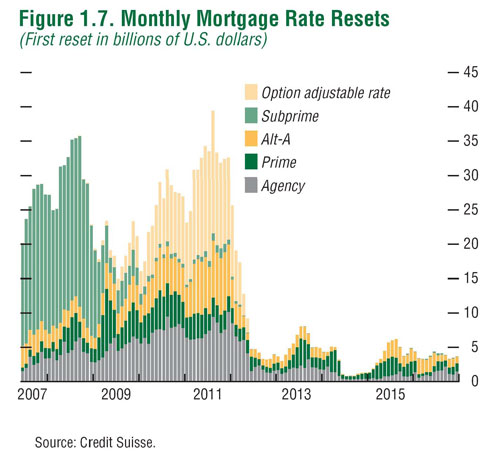
As for Mr. Zandi's comment about the numbers of people being foreclosed on, consider this. It is anticipated that many option-ARM borrowers will face significantly higher monthly payment increases in the near future. How many? The statistics I have seen indicate that loans totaling about $30 billion will reset in 2009 and as much at $70 billion will reset in 2010. These are not sub-prime loans.
As a result, defaults are expected to double again. I think that politicians or economists who expect the housing market crises will “bottom” in early 2009 are absolutely wrong, unless there is strong government intervention to prevent these automatic resets. This event is not a surprise. In March 2008, Goldman Sachs estimated that a 15% decline in housing values would occur and that 21% of the total number of people with a mortgage would owe more than their house was worth. However, it was also estimated that if a recession occurred then there would be a total decline in the value of housing of 30% and a whopping 39% of people owing mortgages would be under water. It is now a certainty that we are in or are entering a serious recession.
I am not certain if our government will intervene until it is too late. At present, congress is working on committees of lynching parties rather than averting this looming crisis. So batten down the hatches and be prepared for a potentially rough ride for the next two or three years. However, the pessimists say it will be 2020 before all of this gets straightened out!
For more on the mortgage resets, go to:
http://letmethinkaboutthis.blogspot.com/2008/10/is-it-greed-or-stupidity.html
Wednesday, October 15, 2008
We're Not the Only One's Feeling the Pain
With the stock market tanked, a recession on the horizon and US government deficits heading toward 10% of GDP, it is important to note that the ordinary middle class citizen isn't the only one feeling pain. After reading this, you may possibly feel a bit better. For example:
James E. "Jimmy" Cayne, former CEO and Chairman of Bear Stearns. His stock in that company was once worth over $1 Billion, but after the company's forced sale to JPMorgan Chase in March 2008, he sold his entire stake in Bear Stearns for "only" $61 million. However, it has been reported that in February, 2008, Mr. Cayne closed on two 14th-floor condominium units overlooking Central Park in New York's Plaza Hotel for $27.4 million.
Former Washington Mutual CEO and Chairman Kerry K. Killinger "exited" WaMu in September 2008, he was given a golden parachute worth $22.3 million which included about 75% in cash, or $16.5 million with the balance in special restricted stock valued at about $5.7 million. Due to the banking crisis, his stock has plummeted and his total package is now worth "only" about $16.5 million. The severance was apparently in recognition of Mr. Killinger's long service to WaMu. In 2001 Mr. Killinger was named American Banker's "Banker of the Year." However, shortly after leaving WaMu, the bank was seized by the FDIC on September 25, 2008 and sold off to JPMorgan Chase in the biggest failure in U.S. banking history.
Former Merrill Lynch & Co., Inc. Chairman and CEO Ernest Stanley "Stan" O'Neal exited ML&C in October 2007 with a golden parachute worth about $161 million. His resignation came on the heel of losses of about $8 billion at ML&C. His severance included about 75% stock and options, retirement benefits of about $25 million, about $5.5 million in deferred compensation and an additional $10 million in performance awards. Due to the financial turmoil, the value of his package was reported as now being worth "only" about $66 million. Mr. O'Neal led ML&CO to a record profit of $4 billion in 2003 after presiding over the elimination of more than 20,000 jobs at that company.
Former CEO and Chairman Charles O. Prince III of Citigroup, who exited that company in November 2007 was given a golden parachute worth about $30 million. This was about 95% stock and options and retirement benefits of about $1.5 million. Due to the turmoil, the value of his package was reported as now being worth "only" about $15 million. It should be noted that at the time Mr. Prince left Citigroup, he had vested stock holdings worth about $94 million and had received about $53 million in salary over the four years he headed Citigroup.
Former President and CEO Martin J. Sullivan of American International Group, who exited that company in June 2008 and was given a golden parachute worth about $48 million. This was about 40% stock and options and cash benefits of about $19 million. Due to the turmoil, the value of his package was reported as now being worth "only" about $35 million. In 2007 Mr. Sullivan was awarded the American Ireland Fund Leadership Award. He is a recipient of The International Center, New York "Award of Excellence" and in 2007 was awarded as a member of the Order of the British Empire.
Former President, Chairman and CEO G. K. Thompson of Wachovia, who exited that company in June 2008 and was given a golden parachute worth about $9 million. This was about 80% stock and options and cash benefits of about $1.5 million. Due to the turmoil, the value of his package was reported as now being worth "only" about $3.5 million. In the most recent fiscal year, his compensation was reported as being about $22 million.
A Historical Perspective
In 2004, the New York Times had an article entitled "For Wall Street Chiefs, Big Paydays Continue". The following is a link and the article is free, although you may have to "log in" as a member of the NYT's online community.
http://query.nytimes.com/gst/fullpage.html?res=9407EED81630F930A15750C0A9629C8B63
James E. "Jimmy" Cayne, former CEO and Chairman of Bear Stearns. His stock in that company was once worth over $1 Billion, but after the company's forced sale to JPMorgan Chase in March 2008, he sold his entire stake in Bear Stearns for "only" $61 million. However, it has been reported that in February, 2008, Mr. Cayne closed on two 14th-floor condominium units overlooking Central Park in New York's Plaza Hotel for $27.4 million.
Former Washington Mutual CEO and Chairman Kerry K. Killinger "exited" WaMu in September 2008, he was given a golden parachute worth $22.3 million which included about 75% in cash, or $16.5 million with the balance in special restricted stock valued at about $5.7 million. Due to the banking crisis, his stock has plummeted and his total package is now worth "only" about $16.5 million. The severance was apparently in recognition of Mr. Killinger's long service to WaMu. In 2001 Mr. Killinger was named American Banker's "Banker of the Year." However, shortly after leaving WaMu, the bank was seized by the FDIC on September 25, 2008 and sold off to JPMorgan Chase in the biggest failure in U.S. banking history.
Former Merrill Lynch & Co., Inc. Chairman and CEO Ernest Stanley "Stan" O'Neal exited ML&C in October 2007 with a golden parachute worth about $161 million. His resignation came on the heel of losses of about $8 billion at ML&C. His severance included about 75% stock and options, retirement benefits of about $25 million, about $5.5 million in deferred compensation and an additional $10 million in performance awards. Due to the financial turmoil, the value of his package was reported as now being worth "only" about $66 million. Mr. O'Neal led ML&CO to a record profit of $4 billion in 2003 after presiding over the elimination of more than 20,000 jobs at that company.
Former CEO and Chairman Charles O. Prince III of Citigroup, who exited that company in November 2007 was given a golden parachute worth about $30 million. This was about 95% stock and options and retirement benefits of about $1.5 million. Due to the turmoil, the value of his package was reported as now being worth "only" about $15 million. It should be noted that at the time Mr. Prince left Citigroup, he had vested stock holdings worth about $94 million and had received about $53 million in salary over the four years he headed Citigroup.
Former President and CEO Martin J. Sullivan of American International Group, who exited that company in June 2008 and was given a golden parachute worth about $48 million. This was about 40% stock and options and cash benefits of about $19 million. Due to the turmoil, the value of his package was reported as now being worth "only" about $35 million. In 2007 Mr. Sullivan was awarded the American Ireland Fund Leadership Award. He is a recipient of The International Center, New York "Award of Excellence" and in 2007 was awarded as a member of the Order of the British Empire.
Former President, Chairman and CEO G. K. Thompson of Wachovia, who exited that company in June 2008 and was given a golden parachute worth about $9 million. This was about 80% stock and options and cash benefits of about $1.5 million. Due to the turmoil, the value of his package was reported as now being worth "only" about $3.5 million. In the most recent fiscal year, his compensation was reported as being about $22 million.
A Historical Perspective
In 2004, the New York Times had an article entitled "For Wall Street Chiefs, Big Paydays Continue". The following is a link and the article is free, although you may have to "log in" as a member of the NYT's online community.
http://query.nytimes.com/gst/fullpage.html?res=9407EED81630F930A15750C0A9629C8B63
Tuesday, October 7, 2008
Comments on the Senator's Letter to Constituents
Here are a few morsels:
To quote the Senator "my proposal, S.2133, which would have authorized the bankruptcy courts to restructure interest and scheduling of payments. The so-called variable rate mortgages have confronted many homeowners with the surprise that original payments, illustratively, of $1200 a month were soon raised to $2000 which resulted in defaults." and "Senator Durbin's proposed legislation, S.2136, which would have authorized the bankruptcy courts to reset the principal balance depending on the value of the home."
Comment: these two proposals would attempt to reward mortgage defaulters. Sen. Specter justifies the courts "restructuring" of variable rate mortgages to avoid the "surprise" confronting "many" homeowners. What is he talking about? The "surpise" that people didn't have sufficient financial knowledge, aka common sense, to make the purchase in the first place and always expected they would have sufficiently increasing earnings to cover their debts, or the surprise that the people who obtained adjustable rate mortgages couldn't flip their houses quickly enough to make money and then move on to their next quick buck scheme? What will that be? Making money through foreclosures? So now the Senators want the taxpayer to pay their defaulted mortgages, thereby keeping these people in their houses and maintaining their lifestyle?
Of course, the rest of us, who practiced LBYM; "living below your means", we haven't defaulted on our mortgages, we pay our creditors and bills on time, and we may have some cash saved "for emergencies". So we can now turn it over to the imbeciles and scafflaws. And why? Because we are responsible with our money, don't take greedy chances with that money. So the Senators' reward to us? We will not be given the opportunity to "restructure interest and the scheduling of payments".
To quote the Senator "my proposal, S.2133, which would have authorized the bankruptcy courts to restructure interest and scheduling of payments. The so-called variable rate mortgages have confronted many homeowners with the surprise that original payments, illustratively, of $1200 a month were soon raised to $2000 which resulted in defaults." and "Senator Durbin's proposed legislation, S.2136, which would have authorized the bankruptcy courts to reset the principal balance depending on the value of the home."
Comment: these two proposals would attempt to reward mortgage defaulters. Sen. Specter justifies the courts "restructuring" of variable rate mortgages to avoid the "surprise" confronting "many" homeowners. What is he talking about? The "surpise" that people didn't have sufficient financial knowledge, aka common sense, to make the purchase in the first place and always expected they would have sufficiently increasing earnings to cover their debts, or the surprise that the people who obtained adjustable rate mortgages couldn't flip their houses quickly enough to make money and then move on to their next quick buck scheme? What will that be? Making money through foreclosures? So now the Senators want the taxpayer to pay their defaulted mortgages, thereby keeping these people in their houses and maintaining their lifestyle?
Of course, the rest of us, who practiced LBYM; "living below your means", we haven't defaulted on our mortgages, we pay our creditors and bills on time, and we may have some cash saved "for emergencies". So we can now turn it over to the imbeciles and scafflaws. And why? Because we are responsible with our money, don't take greedy chances with that money. So the Senators' reward to us? We will not be given the opportunity to "restructure interest and the scheduling of payments".
One Senator's Note to Constituents re: $700B Bill
Thank you for contacting my office regarding the financial rescue legislation. I appreciate your views on this matter.
I reluctantly supported this package because the failure of Congress to act would run the risk of dire consequences, including an economic downturn which could cause more foreclosures, jeopardize retirement accounts, and further restrict credit which is necessary for small businesses to operate. I am philosophically opposed to bailouts. I think that when you have Wall Street entrepreneurs who take big risks to make big profits and they go sour, they ought to sustain the loss themselves and not look to the government for a bailout which ends up in the laps of the taxpayers. However, I supported the plan to avoid economic disaster that would extend well beyond Wall Street.
From the outset, I cautioned against Congress's rushing to judgment. When the initial proposal was made in mid-September, I wrote to Majority Leader Harry Reid and Republican Leader Mitch McConnell by letter dated September 21, 2008 urging we take the time necessary to get the legislation right. By letter dated September 23, 2008, I wrote to Treasury Secretary Henry Paulson and Federal Reserve Chairman Ben Bernanke asking a series of questions which have not yet been answered. Then by letter dated September 27, 2008, accompanied by a Senate floor statement, I made a series of suggestions to the executive and legislative negotiators. Again, there has been insufficient time for a reply. Copies of these letters are available on my website:
http://specter.senate.gov
Whenever we deviate from regular order which has been developed during more than 200 years of serving our country very well, we are on thin ice. On regular order, the legislative process customarily begins with a bill which members of Congress can study and analyze. After the legislation is in hand, there are hearings with proponents and opponents of the bill and an opportunity for members to examine, really cross examine, to get to the heart of the issues and alternatives. Regular order calls for a markup in the committee of jurisdiction going over the language line by line with an opportunity to make changes with votes on those proposed modifications. Then the committee files a report which is reviewed by members in advance of floor action where amendments can be offered and debate occurs. The action by each house is then subjected to further refinement by a conference committee which makes the presentment to the President for yet another line of review. The process used to finalize this legislation drastically shortcut regular order.
The legislation passed by the Senate is enormously improved over the first Paulson proposal. The $700 billion is not to be authorized immediately, but instead there are installments of $250 billion, $100 billion at the request of the president and $350 billion more subject to congressional objection, although the latter phase may be unconstitutional under INS v. Chadha, which requires following regular legislative process with passage by both houses and Presidential approval to overrule Presidential action and perhaps inferentially legislative conditions. For protection of the taxpayers, the proposal contains a provision that if the government does not regain its money after five years, the President would be required to submit a plan for compensating the Treasury "from entities benefiting from the programs." While that provision is a far way from a guarantee or even assurances that such recovery legislation would be enacted, it gives some important comfort to the taxpayers' position.
There are provisions for multiple layers of oversight including a Financial Stability Oversight Board that will meet monthly to oversee the program. The Treasury Secretary will be required to report to Congress on a regular basis on the actions taken, along with a detailed financial statement. These reports will include information on each of the agreements made, insurance contracts entered into, and the nature of the asset purchased and projected costs and liabilities. Additional oversight will be provided by the Comptroller General (reports to Congress), a new Inspector General (audits and quarterly reports), a congressionally-appointed oversight panel (market and regulatory review, and reports to Congress on the program and the effectiveness of foreclosure mitigation efforts), and by the Office of Management and Budget (OMB) and the Congressional Budget Office (CBO) (cost estimates). A report will be required from the Secretary of the Treasury with an analysis of the current financial regulatory framework and recommendations for improvements.
There are substantial limitations on having benefits for entities which created the problem and limitations on executive pay. In cases where financial institutions sell troubled assets directly to the government with no competitive bidding and where the government receives a meaningful equity position, the legislation states that, until that equity stake is sold, executives would not get incentives "to take unnecessary and excessive risks" and would have to give up or repay bonuses or other incentives based on financial statements that "are later proven to be materially inaccurate." The bill also would prohibit "any golden parachute payment to senior executives."
The legislation is less stringent in provisions for financial institutions that sell their assets to the government through an auction. Such provisions would apply only to companies that sell more than $300 million in assets and would subject companies and employees to extra taxes. Corporations would not be able to deduct any salary or deferred compensation of more than $500,000, and top executives would face a 20% excise tax on golden parachute payments if they left for any reason other than retirement. In evaluating limitations on executive salaries, it is relevant to note that the Institute for Public Studies found that chief executives of large U.S. companies made an average of $10.5 million last year. That is more than 300 times the pay of the average worker.
The final proposal does provide for debt insurance, as advocated for by House Republicans, but leaves it to the Secretary of the Treasury to utilize that approach so it seems unlikely that it will be implemented in light of the fact that Secretary Paulson has bluntly stated his disagreement with it. Had there been floor amendments, Congress could have structured standards for utilization of debt insurance.
Had we followed regular order with an opportunity to propose amendments, consideration could have been given to my proposal, S.2133, which would have authorized the bankruptcy courts to restructure interest and scheduling of payments. The so-called variable rate mortgages have confronted many homeowners with the surprise that original payments, illustratively, of $1200 a month were soon raised to $2000 which resulted in defaults. Individualized examination by the bankruptcy courts might show misrepresentation or even fraud to justify revising the interest payments and rearranging the payment schedule. Or consideration could have been given to Senator Durbin's proposed legislation, S.2136, which would have authorized the bankruptcy courts to reset the principal balance depending on the value of the home. I opposed that bill because I thought it would discourage future lending, and in the long run raise the cost to homebuyers. But at least, following regular order, there would have been an opportunity to consider Senator Durbin's proposal as well as my suggested legislation.
The legislation contains authority for the Treasury Secretary to compensate foreign central banks under some conditions. It provides that troubled assets held by foreign financial authorities and banks are eligible for the Toxic Assets Recover Program (TARP) if the banks hold such assets as a result of having extended financing to financial institutions that have failed or defaulted. Had there been an opportunity for floor debate, that provision might have been sufficiently unpopular to be rejected or at least sharply circumscribed with conditions.
As a step to help keep borrowers in their homes, I proposed language found in Section 119 (b) of the bill to address the concern that some loan servicers have been reluctant to modify home mortgage loan terms because they fear litigation from investors who hold securities or other vehicles backed by the mortgage in question. The loan servicers have a legal duty to the investors to maximize the return on their investments. In testimony on December 6, 2007, before the House Committee on Financial Services, Mark Pearce, speaking on behalf of the conference of State Bank supervisors, discussed a meeting with the top 20 subprime servicers. He explained that "many of them brought up fear of investor lawsuits" as a hurdle to voluntary loan modification efforts. Because the rescue legislation encourages the government to seek voluntary loan modifications, it is important to remove any impediments to such modifications. To that end, the language provides a legal safe harbor for mortgage servicers making loan modifications, if the loan modifiers take reasonable mitigation steps, including accepting partial payments from homeowners.
On reforms to prevent a recurrence of this crisis, we need to question whether the rating agencies adequately analyzed mortgage-backed securities before issuing investment-grade ratings. These agencies appear to have failed. In July of 2007, when it became apparent that ratings issued by the big three rating agencies-Moody's, S&P and Fitch- could not be relied upon, I urged the relevant committees to look into the ratings that those agencies issued in recent years regarding mortgage-backed securities. Financial institutions that issue asset-backed securities obtain ratings for such securities. The failure to issue reliable ratings misrepresented the facts and fed the ability of financial institutions to tout the value of securities even though their value was declining. Congress and the regulators need to take up the rating agencies issue, and consider whether ratings agencies that have utterly failed to detect and reflect the risks associated with the securities they were rating should be accorded any reliance or role in our financial system. Some have suggested they should be regulated and we may need to consider that.
In addition, Congress and the regulators should review "off-balance sheet" transactions and leveraging. There should be a close examination on whether banks are sufficiently transparent and providing accurate accounting that truly reflects risk and leverage. Similarly there should be a review on Credit Default Swaps (CDS), which are privately traded derivatives contracts that have ballooned to make up what is a $2 trillion dollar market according to the Bank of International Settlements. They are a fast-growing major type of financial derivative. Many experts assert that they have played a critical role in this financial crisis as various financial players believed that they were safe because they thought CDS fully insured or protected them, but the CDS market is unregulated and no one really knows what exposure everyone else has from the CDS contracts. Consideration should be given to subjecting all over-the-counter derivatives onto a regulated exchange similar to that used by listed options in the equity markets.
Overleveraging has been a contributing factor in the turmoil that now threatens our financial institutions. We have seen a massive expansion of the practice of leveraged financial institutions (banks, investment banks, and hedge funds) making investments with borrowed money. In turn, they borrow more money by using the assets they just purchased as collateral. This sequence is continued again and again. The financial system, in its efforts to deleverage, is contracting credit. They must guard against future losses by holding more capital. Deleveraging is leading to difficulty on Main Street for individuals seeking to get a mortgage or buy a car. If a financial institution is able to unload its toxic assets onto the government, it will again be able to resume its lending activities that are crucial for economic growth in the United States. Unfortunately, much of the financial crisis has arisen from miscalculations of the risks involved with purchasing large amounts of securities backed by subprime mortgages and other toxic assets. We now see a situation where we are not just talking about a handful of firms. This is a widespread problem that should be addressed by this package and in future reforms of our financial regulatory structure.
In addition, the package crafted by Senate leaders includes two notable changes from the version that was rejected by the House on Monday. It includes a tax package that was previously passed in the Senate by a vote of 93-2 on September 23, 2008, but has since been rejected by the House in a dispute over revenue offsets. It includes tax incentives for wind, solar, biomass, and other alternative energy technologies. It also includes critically important relief from the Alternative Minimum Tax, which threatens to raise the tax liability of over 22 million unintended filers in 2008 if no action is taken. Finally, the package includes a host of provisions that either expired in 2007 or are set to expire in 2008, including the research and development tax credit, rail line improvement incentives, and quicker restaurant and retail depreciation schedules. I supported the Senate-passed tax extenders bill because it struck a responsible balance on the issue of revenue raising offsets.
The package also includes a provision to temporarily increase the Federal Deposit Insurance Corporation (FDIC) insurance limit to $250,000. Currently, the FDIC provides deposit insurance which guarantees the safety of checking and savings deposits in member banks, up to $100,000 per depositor per bank. Member banks pay a fee to participate. The current $100,000 limit has been unchanged since 1980 despite inflation. This approach is supported by both Senator McCain and Senator Obama, by House Republicans, and by the FDIC Chairman Sheila Bair. Raising the cap could stem a potential run on deposits by bank customers, particularly businesses, who fear losing their money. Such fears contributed to the collapse of Washington Mutual and Wachovia Bank.
Congress has been called upon to make the best of a very bad situation. Careful oversight of the authority given to the Treasury Department will need to be undertaken, and a review of our regulatory structure will be necessary as we move forward.
Again, thank you for writing. The concerns of my constituents are of great importance to me, and I rely on you and other Pennsylvanians to inform me of your views. If you require assistance with a federal agency, please contact my state office in your area. The contact information can be found on my website at specter.senate.gov.
Sincerely,
Arlen Specter
I reluctantly supported this package because the failure of Congress to act would run the risk of dire consequences, including an economic downturn which could cause more foreclosures, jeopardize retirement accounts, and further restrict credit which is necessary for small businesses to operate. I am philosophically opposed to bailouts. I think that when you have Wall Street entrepreneurs who take big risks to make big profits and they go sour, they ought to sustain the loss themselves and not look to the government for a bailout which ends up in the laps of the taxpayers. However, I supported the plan to avoid economic disaster that would extend well beyond Wall Street.
From the outset, I cautioned against Congress's rushing to judgment. When the initial proposal was made in mid-September, I wrote to Majority Leader Harry Reid and Republican Leader Mitch McConnell by letter dated September 21, 2008 urging we take the time necessary to get the legislation right. By letter dated September 23, 2008, I wrote to Treasury Secretary Henry Paulson and Federal Reserve Chairman Ben Bernanke asking a series of questions which have not yet been answered. Then by letter dated September 27, 2008, accompanied by a Senate floor statement, I made a series of suggestions to the executive and legislative negotiators. Again, there has been insufficient time for a reply. Copies of these letters are available on my website:
http://specter.senate.gov
Whenever we deviate from regular order which has been developed during more than 200 years of serving our country very well, we are on thin ice. On regular order, the legislative process customarily begins with a bill which members of Congress can study and analyze. After the legislation is in hand, there are hearings with proponents and opponents of the bill and an opportunity for members to examine, really cross examine, to get to the heart of the issues and alternatives. Regular order calls for a markup in the committee of jurisdiction going over the language line by line with an opportunity to make changes with votes on those proposed modifications. Then the committee files a report which is reviewed by members in advance of floor action where amendments can be offered and debate occurs. The action by each house is then subjected to further refinement by a conference committee which makes the presentment to the President for yet another line of review. The process used to finalize this legislation drastically shortcut regular order.
The legislation passed by the Senate is enormously improved over the first Paulson proposal. The $700 billion is not to be authorized immediately, but instead there are installments of $250 billion, $100 billion at the request of the president and $350 billion more subject to congressional objection, although the latter phase may be unconstitutional under INS v. Chadha, which requires following regular legislative process with passage by both houses and Presidential approval to overrule Presidential action and perhaps inferentially legislative conditions. For protection of the taxpayers, the proposal contains a provision that if the government does not regain its money after five years, the President would be required to submit a plan for compensating the Treasury "from entities benefiting from the programs." While that provision is a far way from a guarantee or even assurances that such recovery legislation would be enacted, it gives some important comfort to the taxpayers' position.
There are provisions for multiple layers of oversight including a Financial Stability Oversight Board that will meet monthly to oversee the program. The Treasury Secretary will be required to report to Congress on a regular basis on the actions taken, along with a detailed financial statement. These reports will include information on each of the agreements made, insurance contracts entered into, and the nature of the asset purchased and projected costs and liabilities. Additional oversight will be provided by the Comptroller General (reports to Congress), a new Inspector General (audits and quarterly reports), a congressionally-appointed oversight panel (market and regulatory review, and reports to Congress on the program and the effectiveness of foreclosure mitigation efforts), and by the Office of Management and Budget (OMB) and the Congressional Budget Office (CBO) (cost estimates). A report will be required from the Secretary of the Treasury with an analysis of the current financial regulatory framework and recommendations for improvements.
There are substantial limitations on having benefits for entities which created the problem and limitations on executive pay. In cases where financial institutions sell troubled assets directly to the government with no competitive bidding and where the government receives a meaningful equity position, the legislation states that, until that equity stake is sold, executives would not get incentives "to take unnecessary and excessive risks" and would have to give up or repay bonuses or other incentives based on financial statements that "are later proven to be materially inaccurate." The bill also would prohibit "any golden parachute payment to senior executives."
The legislation is less stringent in provisions for financial institutions that sell their assets to the government through an auction. Such provisions would apply only to companies that sell more than $300 million in assets and would subject companies and employees to extra taxes. Corporations would not be able to deduct any salary or deferred compensation of more than $500,000, and top executives would face a 20% excise tax on golden parachute payments if they left for any reason other than retirement. In evaluating limitations on executive salaries, it is relevant to note that the Institute for Public Studies found that chief executives of large U.S. companies made an average of $10.5 million last year. That is more than 300 times the pay of the average worker.
The final proposal does provide for debt insurance, as advocated for by House Republicans, but leaves it to the Secretary of the Treasury to utilize that approach so it seems unlikely that it will be implemented in light of the fact that Secretary Paulson has bluntly stated his disagreement with it. Had there been floor amendments, Congress could have structured standards for utilization of debt insurance.
Had we followed regular order with an opportunity to propose amendments, consideration could have been given to my proposal, S.2133, which would have authorized the bankruptcy courts to restructure interest and scheduling of payments. The so-called variable rate mortgages have confronted many homeowners with the surprise that original payments, illustratively, of $1200 a month were soon raised to $2000 which resulted in defaults. Individualized examination by the bankruptcy courts might show misrepresentation or even fraud to justify revising the interest payments and rearranging the payment schedule. Or consideration could have been given to Senator Durbin's proposed legislation, S.2136, which would have authorized the bankruptcy courts to reset the principal balance depending on the value of the home. I opposed that bill because I thought it would discourage future lending, and in the long run raise the cost to homebuyers. But at least, following regular order, there would have been an opportunity to consider Senator Durbin's proposal as well as my suggested legislation.
The legislation contains authority for the Treasury Secretary to compensate foreign central banks under some conditions. It provides that troubled assets held by foreign financial authorities and banks are eligible for the Toxic Assets Recover Program (TARP) if the banks hold such assets as a result of having extended financing to financial institutions that have failed or defaulted. Had there been an opportunity for floor debate, that provision might have been sufficiently unpopular to be rejected or at least sharply circumscribed with conditions.
As a step to help keep borrowers in their homes, I proposed language found in Section 119 (b) of the bill to address the concern that some loan servicers have been reluctant to modify home mortgage loan terms because they fear litigation from investors who hold securities or other vehicles backed by the mortgage in question. The loan servicers have a legal duty to the investors to maximize the return on their investments. In testimony on December 6, 2007, before the House Committee on Financial Services, Mark Pearce, speaking on behalf of the conference of State Bank supervisors, discussed a meeting with the top 20 subprime servicers. He explained that "many of them brought up fear of investor lawsuits" as a hurdle to voluntary loan modification efforts. Because the rescue legislation encourages the government to seek voluntary loan modifications, it is important to remove any impediments to such modifications. To that end, the language provides a legal safe harbor for mortgage servicers making loan modifications, if the loan modifiers take reasonable mitigation steps, including accepting partial payments from homeowners.
On reforms to prevent a recurrence of this crisis, we need to question whether the rating agencies adequately analyzed mortgage-backed securities before issuing investment-grade ratings. These agencies appear to have failed. In July of 2007, when it became apparent that ratings issued by the big three rating agencies-Moody's, S&P and Fitch- could not be relied upon, I urged the relevant committees to look into the ratings that those agencies issued in recent years regarding mortgage-backed securities. Financial institutions that issue asset-backed securities obtain ratings for such securities. The failure to issue reliable ratings misrepresented the facts and fed the ability of financial institutions to tout the value of securities even though their value was declining. Congress and the regulators need to take up the rating agencies issue, and consider whether ratings agencies that have utterly failed to detect and reflect the risks associated with the securities they were rating should be accorded any reliance or role in our financial system. Some have suggested they should be regulated and we may need to consider that.
In addition, Congress and the regulators should review "off-balance sheet" transactions and leveraging. There should be a close examination on whether banks are sufficiently transparent and providing accurate accounting that truly reflects risk and leverage. Similarly there should be a review on Credit Default Swaps (CDS), which are privately traded derivatives contracts that have ballooned to make up what is a $2 trillion dollar market according to the Bank of International Settlements. They are a fast-growing major type of financial derivative. Many experts assert that they have played a critical role in this financial crisis as various financial players believed that they were safe because they thought CDS fully insured or protected them, but the CDS market is unregulated and no one really knows what exposure everyone else has from the CDS contracts. Consideration should be given to subjecting all over-the-counter derivatives onto a regulated exchange similar to that used by listed options in the equity markets.
Overleveraging has been a contributing factor in the turmoil that now threatens our financial institutions. We have seen a massive expansion of the practice of leveraged financial institutions (banks, investment banks, and hedge funds) making investments with borrowed money. In turn, they borrow more money by using the assets they just purchased as collateral. This sequence is continued again and again. The financial system, in its efforts to deleverage, is contracting credit. They must guard against future losses by holding more capital. Deleveraging is leading to difficulty on Main Street for individuals seeking to get a mortgage or buy a car. If a financial institution is able to unload its toxic assets onto the government, it will again be able to resume its lending activities that are crucial for economic growth in the United States. Unfortunately, much of the financial crisis has arisen from miscalculations of the risks involved with purchasing large amounts of securities backed by subprime mortgages and other toxic assets. We now see a situation where we are not just talking about a handful of firms. This is a widespread problem that should be addressed by this package and in future reforms of our financial regulatory structure.
In addition, the package crafted by Senate leaders includes two notable changes from the version that was rejected by the House on Monday. It includes a tax package that was previously passed in the Senate by a vote of 93-2 on September 23, 2008, but has since been rejected by the House in a dispute over revenue offsets. It includes tax incentives for wind, solar, biomass, and other alternative energy technologies. It also includes critically important relief from the Alternative Minimum Tax, which threatens to raise the tax liability of over 22 million unintended filers in 2008 if no action is taken. Finally, the package includes a host of provisions that either expired in 2007 or are set to expire in 2008, including the research and development tax credit, rail line improvement incentives, and quicker restaurant and retail depreciation schedules. I supported the Senate-passed tax extenders bill because it struck a responsible balance on the issue of revenue raising offsets.
The package also includes a provision to temporarily increase the Federal Deposit Insurance Corporation (FDIC) insurance limit to $250,000. Currently, the FDIC provides deposit insurance which guarantees the safety of checking and savings deposits in member banks, up to $100,000 per depositor per bank. Member banks pay a fee to participate. The current $100,000 limit has been unchanged since 1980 despite inflation. This approach is supported by both Senator McCain and Senator Obama, by House Republicans, and by the FDIC Chairman Sheila Bair. Raising the cap could stem a potential run on deposits by bank customers, particularly businesses, who fear losing their money. Such fears contributed to the collapse of Washington Mutual and Wachovia Bank.
Congress has been called upon to make the best of a very bad situation. Careful oversight of the authority given to the Treasury Department will need to be undertaken, and a review of our regulatory structure will be necessary as we move forward.
Again, thank you for writing. The concerns of my constituents are of great importance to me, and I rely on you and other Pennsylvanians to inform me of your views. If you require assistance with a federal agency, please contact my state office in your area. The contact information can be found on my website at specter.senate.gov.
Sincerely,
Arlen Specter
Wednesday, October 1, 2008
Secretary of the Treasury to be given broad powers to hire outside firms
It was reported today in the Washington Post that as a part of the HR3997 and possibly also the Senate version, Secretary of the Treasury Paulson will be give broad powers to hire contractors to administer the $700B he will be spreading to banks and investment banks, both foreign and domestic.
To quote Joe Davidson in the Washington Post: "Treasury Secretary Henry M. Paulson Jr. wants the ability to move quickly to smooth the very rocky road that is now Wall Street. He proposed granting his office essentially unlimited authority to hire outside firms to help manage the assets of companies the government basically nationalizes."
What a deal! Wall Street creates this mess and then gets bailed out and collects fees!
http://www.washingtonpost.com/wp-dyn/content/article/2008/09/29/AR2008092903163.html
http://www.washingtontechnology.com/online/1_1/33599-1.html
To quote Joe Davidson in the Washington Post: "Treasury Secretary Henry M. Paulson Jr. wants the ability to move quickly to smooth the very rocky road that is now Wall Street. He proposed granting his office essentially unlimited authority to hire outside firms to help manage the assets of companies the government basically nationalizes."
What a deal! Wall Street creates this mess and then gets bailed out and collects fees!
http://www.washingtonpost.com/wp-dyn/content/article/2008/09/29/AR2008092903163.html
http://www.washingtontechnology.com/online/1_1/33599-1.html
Tuesday, September 30, 2008
Thanked my Congressman for Voting Against HR3997
I have read HR3997 and I am convinced this is a bad deal. I am also disappointed that so many of our politicians have been so poor in articulating the probem; don't just tell me it's no good (another version of "trust me; I'm more knowedgeable than you", or "it's too complicated and you would never understand it"). Don't pander to me either; simply tell me "why" in plain english!!!
This is the note I emailed and faxed to my congressman:
"Thank you for voting against HR 3997 Emergency Economic Stabilization Act of 2008.
I read the act and I have many questions. One of which is, why are we including the troubled assets of "any" financial institution, and specifically "foreign authorities and central banks"?
I further agree with the numerous statements of Rep. Marcy Kaptur, D. Ohio on the subject of rushing to bail out wall street and ignoring the problems on main street.
I understand the compexity and the issues of bailing out home owners who may have made poor decisions or stupid ones. However, why are we spending $700B (or at the very least guaranteeing that amount)???
There must be a better way that protects american assets, provides the credit that the markets requires and does not hand billions of dollars to the same people who got us into this mess in the first place. If this problem is so complex, that ordinary citizens can't understand it, as has been said, then I must question the wisdom of the people who got us into the mess in the first place.
They obviously didn't understand the compexity of what they were doing, or if they did, they they made rash and equally poor decisions and must not be trusted to implement a solution.
Thank you again!"
This is the note I emailed and faxed to my congressman:
"Thank you for voting against HR 3997 Emergency Economic Stabilization Act of 2008.
I read the act and I have many questions. One of which is, why are we including the troubled assets of "any" financial institution, and specifically "foreign authorities and central banks"?
I further agree with the numerous statements of Rep. Marcy Kaptur, D. Ohio on the subject of rushing to bail out wall street and ignoring the problems on main street.
I understand the compexity and the issues of bailing out home owners who may have made poor decisions or stupid ones. However, why are we spending $700B (or at the very least guaranteeing that amount)???
There must be a better way that protects american assets, provides the credit that the markets requires and does not hand billions of dollars to the same people who got us into this mess in the first place. If this problem is so complex, that ordinary citizens can't understand it, as has been said, then I must question the wisdom of the people who got us into the mess in the first place.
They obviously didn't understand the compexity of what they were doing, or if they did, they they made rash and equally poor decisions and must not be trusted to implement a solution.
Thank you again!"
Full Text of "HR 3997 Emergency Economic Stabilization Act of 2008"
The following site has the full text of the ""HR 3997 Emergency Economic Stabilization Act of 2008"
http://www.rules.house.gov/110/text/110_hr3997_amnd_samnd.pdf
HR 3997 is a 109 page document. The following is a condensation of the first 32 pages including selected excerpts:
The US Government, that is, the US Taxpayer, will establish a fund called "the TARP" and will purchase "any and all" of the troubled assets from "any" financial institution. This includes "foreign authorities and central banks". The terms and conditions (if any) will be determined by the Secretary of the Treasury.
Everyone, that is, Paulson and the politicians in favor of this legislation, say there is a "good chance" the taxpayer will break even on this. However, this could only be a good deal for the taxpayer if the government were to purchase the troubled assets at market prices. However, our government has already said it WILL NOT be paying market prices. Our government will purchase these troubled assets by paying ABOVE MARKET prices. It appears the purpose of this legislation is to recapitalize the banks without getting much equity in exchange. The cost of this WILL be passed on to the taxpayer!
It gets worse. What "troubled assets" are we talking about? "Any residential or commercial mortgages and any securities, obligations, or other instruments that are based on or related to such mortgages...originated on or before March 14, 2008...[and] any other financial instrument that the Secretary after consultation with the Chairman...of the Federal Reserve System,"
"The Secretary shall take such steps as my be necessary to prevent unjust enrichment of financial institutions participating in a program established under this section [section 101 - purchases of troubled assets]."
There is also a provision for an "insurance program". This is contained in "Sec. 102. Insurance of Troubled Assets". "the Secretary shall establish a program to guarantee troubled assets originated or issued prior to March 14, 2008". "the Secretary may guarantee the timely payment of principal of, and interest on, troubled assets in the amounts not to exceed 100 percent of such payments." "the Secretary shall collect premiums from any financial institutions participating in the program". "Such premiums shall be in the amount that the Secretary determines necessary to meet the purposes of this Act and to provide sufficient reserves ["to meet anticipated claims, based on an actuarial analysis, and to ensure that taxpayers are fully protected."]."
The Secretary will be "providing financial assistance to financial institutions... that have assets less than $1,000,000,000, that were well or adequately capitalized as of June 30, 2008, and that as a result of the devaluation of the preferred government sponsored enterprises stock will drop one or more capital levels..".
The Secretary will be "protecting the retirement security of Americans by purchasing troubled assets held by or on behalf of eligible retirement plan described in clause (iii), (iv), (v) or (vi) of section 402(c)(8)(B) of the Internal Revenue Code of 1986 except...not compensation arrangements subject to section 409A..". "and the utility of purchasing other real estate owned and instruments backed by mortgages on multifamily properties." [Note: IRS section 402(c)(8)(B) defines an "eligible retirement plan" as (i) and individual retirement account as described in Code section 408(a), (ii) an individual retirement annuity as described in Code section 408(b), (iii) a section 401(a) qualified retirement plan, and (iv) and an annuity plan as described in section 403(a)].
"there is established the Financial Stability Oversight Board, which shall be responsible for...reviewing the exercise of authority under..this Act, including.. policies implemented by the Secretary and the Office of Financial Stability...including appointment of financial agents [and]... the asset classes to be purchased.." The FSOB will be "reporting any suspected fraud, misrepresentation, or malfeasance to the Special Inspector General for the Troubled Assets Relief Program.."
"The Financial Stability Oversight Board shall be comprised of..the Chairman of..the Federal Reserve System, the Secretary, the Director of the FHA, the Chairman of the SEC and the Secretary of HUD." "The chairperson shall be elected by the members of the board of the FSOB from among the members other than the Secretary."
The bill includes a list of reporting requirements.
Section 106 of the bill pertains to "Rights; Management; Sale of Troubled Assets; Revenues and Sale Proceeds". "the Secretary shall have authority to manage troubled assets purchased under this Act, including revenues and portfolio risks therefrom." "the Secretary may, at any time...sell or enter into securities loans, repurchase transactions, or other financial transactions in regard to, any troubled asset purchased under this Act." "Revenues...shall be paid into the general fund of the Treasury for the reduction of public debt."
Steamlined Process. "the Secretary may waive specific provisions of the Federal Acquisition Regulation upon a determination that urgent and compelling circumstances make compliance with such provisions contrary to the public interest."
"Additional Contracting Requirements. In any solicitation or contract....to the maximum extent practicable, the inclusion and utilization of minorities...and women- and minority and women-owned business."
"Eligibility of FDIC". "the Corporation...shall be elibible for...selection of asset managers for residential mortgage loans and residential mortgage-backed securities, and shall be reimbursed by the Secretary for any services provided."
Section "108. Conflicts of Interest." "The Secretary shall issue regulations or guidelines...to address and manage or to prohibit conflicts of interest..."
Section "109. Foreclosure Mitigation Efforts." "the Secretary shall implement a plan that seeks to maximize assistance for homeowners and use the authority of the Secretary to encourage the servicers of the underlying mortgages, considering net present value to the taxpayer, to tak advantage of the HOPE for Homeowners Program..".
Section "110. Assistance to Homeowners". To the extent that the [FHFA, bridge depository institution of the FDIC, Federal Reserve Bank] holds, owns or controls mortgages, mortgage backed securities, and other assets secured by residential real estate including multi-family housing...shall implement a plan that seeks to maximize assistance for homeowners and use its authority to encourage the servicers of underlying mortgages, and considering net present value to taxpayer, to take advantage of the HOPE for Homeowners Program...". Modifications... of a residentail mortgage loan... may include... reduction in interest rates, reduction in loan principal and other similar modifications. Tenant protections..on residential rental properties, modifications..shall ensure...the continuation of existing...subisidies; and that modifications take into account the need for operating funds to maintain decent living conditions at the property.
"Actions with respect to servicers. In any case in which [the FHFA, bridge depository institution of the FDIC, Federal Reserve Bank] is not the owner of a residential mortgage loand, but holds an interest in obligations or pools of obligations secured by residential morgage loans, the [FHFA, bridge depository institution of the FDIC, Federal Reserve Bank] shall encourage implementation by the loan servicers of loan modifications developed in section (b) [Homeowner Assistance by agencies] and... assist in facilitating such modifications...".
Section "111. Executive Compensation and Corporate Governance". "Any financial institution that sell troubled assets to the Secretary under this Act shall be subject to the executive compensation requirements of subsections (b) and (c) and the provisions under the Internal Revenue Code of 1986, as provided under the amendment by section 302, as applicable". " The standards requited under this subsection [criteria] shall include...limits on compensation that exclude incentives for senior executive officers [defined as one of the 5 top highly paid executives of a public company, whose compensation is required to be disclosed pursuant to SEC act of 1934...] of a financial institution to take unnecessary and excessive risks...". "A provision for the recovery by the financial institution of any bonus or incentive compensation paid to a senior exective officer...based on statements of earnings, gains or other criteria that are later proven to be materially inaccurate; and ...a prohibition on ...making golden parachute payment..".
Section "112. Coordination with Foreign Authorities and Central Banks." "...to the extent that such foreign authorities or banks hold troubled assets as a result of extending financing to financial institutions that have failed or defaulted on such financing, such troubled assets qualify for purchase...".
http://www.rules.house.gov/110/text/110_hr3997_amnd_samnd.pdf
HR 3997 is a 109 page document. The following is a condensation of the first 32 pages including selected excerpts:
The US Government, that is, the US Taxpayer, will establish a fund called "the TARP" and will purchase "any and all" of the troubled assets from "any" financial institution. This includes "foreign authorities and central banks". The terms and conditions (if any) will be determined by the Secretary of the Treasury.
Everyone, that is, Paulson and the politicians in favor of this legislation, say there is a "good chance" the taxpayer will break even on this. However, this could only be a good deal for the taxpayer if the government were to purchase the troubled assets at market prices. However, our government has already said it WILL NOT be paying market prices. Our government will purchase these troubled assets by paying ABOVE MARKET prices. It appears the purpose of this legislation is to recapitalize the banks without getting much equity in exchange. The cost of this WILL be passed on to the taxpayer!
It gets worse. What "troubled assets" are we talking about? "Any residential or commercial mortgages and any securities, obligations, or other instruments that are based on or related to such mortgages...originated on or before March 14, 2008...[and] any other financial instrument that the Secretary after consultation with the Chairman...of the Federal Reserve System,"
"The Secretary shall take such steps as my be necessary to prevent unjust enrichment of financial institutions participating in a program established under this section [section 101 - purchases of troubled assets]."
There is also a provision for an "insurance program". This is contained in "Sec. 102. Insurance of Troubled Assets". "the Secretary shall establish a program to guarantee troubled assets originated or issued prior to March 14, 2008". "the Secretary may guarantee the timely payment of principal of, and interest on, troubled assets in the amounts not to exceed 100 percent of such payments." "the Secretary shall collect premiums from any financial institutions participating in the program". "Such premiums shall be in the amount that the Secretary determines necessary to meet the purposes of this Act and to provide sufficient reserves ["to meet anticipated claims, based on an actuarial analysis, and to ensure that taxpayers are fully protected."]."
The Secretary will be "providing financial assistance to financial institutions... that have assets less than $1,000,000,000, that were well or adequately capitalized as of June 30, 2008, and that as a result of the devaluation of the preferred government sponsored enterprises stock will drop one or more capital levels..".
The Secretary will be "protecting the retirement security of Americans by purchasing troubled assets held by or on behalf of eligible retirement plan described in clause (iii), (iv), (v) or (vi) of section 402(c)(8)(B) of the Internal Revenue Code of 1986 except...not compensation arrangements subject to section 409A..". "and the utility of purchasing other real estate owned and instruments backed by mortgages on multifamily properties." [Note: IRS section 402(c)(8)(B) defines an "eligible retirement plan" as (i) and individual retirement account as described in Code section 408(a), (ii) an individual retirement annuity as described in Code section 408(b), (iii) a section 401(a) qualified retirement plan, and (iv) and an annuity plan as described in section 403(a)].
"there is established the Financial Stability Oversight Board, which shall be responsible for...reviewing the exercise of authority under..this Act, including.. policies implemented by the Secretary and the Office of Financial Stability...including appointment of financial agents [and]... the asset classes to be purchased.." The FSOB will be "reporting any suspected fraud, misrepresentation, or malfeasance to the Special Inspector General for the Troubled Assets Relief Program.."
"The Financial Stability Oversight Board shall be comprised of..the Chairman of..the Federal Reserve System, the Secretary, the Director of the FHA, the Chairman of the SEC and the Secretary of HUD." "The chairperson shall be elected by the members of the board of the FSOB from among the members other than the Secretary."
The bill includes a list of reporting requirements.
Section 106 of the bill pertains to "Rights; Management; Sale of Troubled Assets; Revenues and Sale Proceeds". "the Secretary shall have authority to manage troubled assets purchased under this Act, including revenues and portfolio risks therefrom." "the Secretary may, at any time...sell or enter into securities loans, repurchase transactions, or other financial transactions in regard to, any troubled asset purchased under this Act." "Revenues...shall be paid into the general fund of the Treasury for the reduction of public debt."
Steamlined Process. "the Secretary may waive specific provisions of the Federal Acquisition Regulation upon a determination that urgent and compelling circumstances make compliance with such provisions contrary to the public interest."
"Additional Contracting Requirements. In any solicitation or contract....to the maximum extent practicable, the inclusion and utilization of minorities...and women- and minority and women-owned business."
"Eligibility of FDIC". "the Corporation...shall be elibible for...selection of asset managers for residential mortgage loans and residential mortgage-backed securities, and shall be reimbursed by the Secretary for any services provided."
Section "108. Conflicts of Interest." "The Secretary shall issue regulations or guidelines...to address and manage or to prohibit conflicts of interest..."
Section "109. Foreclosure Mitigation Efforts." "the Secretary shall implement a plan that seeks to maximize assistance for homeowners and use the authority of the Secretary to encourage the servicers of the underlying mortgages, considering net present value to the taxpayer, to tak advantage of the HOPE for Homeowners Program..".
Section "110. Assistance to Homeowners". To the extent that the [FHFA, bridge depository institution of the FDIC, Federal Reserve Bank] holds, owns or controls mortgages, mortgage backed securities, and other assets secured by residential real estate including multi-family housing...shall implement a plan that seeks to maximize assistance for homeowners and use its authority to encourage the servicers of underlying mortgages, and considering net present value to taxpayer, to take advantage of the HOPE for Homeowners Program...". Modifications... of a residentail mortgage loan... may include... reduction in interest rates, reduction in loan principal and other similar modifications. Tenant protections..on residential rental properties, modifications..shall ensure...the continuation of existing...subisidies; and that modifications take into account the need for operating funds to maintain decent living conditions at the property.
"Actions with respect to servicers. In any case in which [the FHFA, bridge depository institution of the FDIC, Federal Reserve Bank] is not the owner of a residential mortgage loand, but holds an interest in obligations or pools of obligations secured by residential morgage loans, the [FHFA, bridge depository institution of the FDIC, Federal Reserve Bank] shall encourage implementation by the loan servicers of loan modifications developed in section (b) [Homeowner Assistance by agencies] and... assist in facilitating such modifications...".
Section "111. Executive Compensation and Corporate Governance". "Any financial institution that sell troubled assets to the Secretary under this Act shall be subject to the executive compensation requirements of subsections (b) and (c) and the provisions under the Internal Revenue Code of 1986, as provided under the amendment by section 302, as applicable". " The standards requited under this subsection [criteria] shall include...limits on compensation that exclude incentives for senior executive officers [defined as one of the 5 top highly paid executives of a public company, whose compensation is required to be disclosed pursuant to SEC act of 1934...] of a financial institution to take unnecessary and excessive risks...". "A provision for the recovery by the financial institution of any bonus or incentive compensation paid to a senior exective officer...based on statements of earnings, gains or other criteria that are later proven to be materially inaccurate; and ...a prohibition on ...making golden parachute payment..".
Section "112. Coordination with Foreign Authorities and Central Banks." "...to the extent that such foreign authorities or banks hold troubled assets as a result of extending financing to financial institutions that have failed or defaulted on such financing, such troubled assets qualify for purchase...".
Monday, September 29, 2008
"No Banker Left Behind" Bailout Fails
Just got the word, the House failed to pass the $700B bailout bill with a vote of 205-228 against the plan.
It was just a few hours ago that a conciliatory sounding House Speaker Pelosi announced calmly that an agreement had been reached. I read the statement released by the House Speaker and it was very matter of fact with none of the political bile that Pelosi likes to interject at any opportunity.
However, Pelosi just couldn't keep her mouth shut and so she reverted to her normal "Party First" position and decided to give another one of her speeches in which she claimed credit for rescuing the economy for the Democrats and blasted Republicans for their resistance. So what was the result? She succeeded in driving away Republican votes. Other Democrats in the House, apparently fearful of looking timid and backing the bankers, and therefore fearful for their seats, bailed.
Here is what Pelosi said from the floor. You decide who screwed this one up:
"Today, we will act to avert this crisis, but informed by our experience of the past eight years with the failed economic leadership that has left us left capable of meeting the challenges of the future. We choose a different path. In the new year, with a new Congress and a new president, we will break free with a failed past and take America in a New Direction to a better future."
Note the marked difference of the above from the statement she issued on Sunday:
"Significant bipartisan work has built consensus around dramatic improvements to the original Bush-Paulson plan to stabilize American financial markets -- including cutting in half the Administration's initial request for $700 billion and requiring Congressional review for any future commitment of taxpayers' funds. If the government loses money, the financial industry will pay back the taxpayers."
I think we ought to give Speaker Pelosi a "Good Job" button for keeping party first and maintaining the reputation of the "Do Nothing and Say NO to Everything" 101st Congress!
The Bushwhacking that has been going on by this "Do Nothing, Say "No" to Everything" Congress finally came home to roost. They thought they were above the fray. Not so and the electorate has spoken: "We don't trust any of you" and for good reason. So when the chips were down, the Democrats ran. And the electorate won!
The game of "party first" has finally turned the electorate on the self styled aristocrats and the rich bankers. Two years of party bickering and jockeying to take over the white house has come to roost. I don't think we'll be listening to debates about Iraq any longer; that one has been milked for all it was worth and now the politicians are forced to face real issues.
I suspect the electorate isn't crazy and we all want this resolved in a manner in which the economy can go forward. I certainly don't trust these politicians and the line has to be drawn somewhere. Enough is enough!
Good, may the games begin!
It was just a few hours ago that a conciliatory sounding House Speaker Pelosi announced calmly that an agreement had been reached. I read the statement released by the House Speaker and it was very matter of fact with none of the political bile that Pelosi likes to interject at any opportunity.
However, Pelosi just couldn't keep her mouth shut and so she reverted to her normal "Party First" position and decided to give another one of her speeches in which she claimed credit for rescuing the economy for the Democrats and blasted Republicans for their resistance. So what was the result? She succeeded in driving away Republican votes. Other Democrats in the House, apparently fearful of looking timid and backing the bankers, and therefore fearful for their seats, bailed.
Here is what Pelosi said from the floor. You decide who screwed this one up:
"Today, we will act to avert this crisis, but informed by our experience of the past eight years with the failed economic leadership that has left us left capable of meeting the challenges of the future. We choose a different path. In the new year, with a new Congress and a new president, we will break free with a failed past and take America in a New Direction to a better future."
Note the marked difference of the above from the statement she issued on Sunday:
"Significant bipartisan work has built consensus around dramatic improvements to the original Bush-Paulson plan to stabilize American financial markets -- including cutting in half the Administration's initial request for $700 billion and requiring Congressional review for any future commitment of taxpayers' funds. If the government loses money, the financial industry will pay back the taxpayers."
I think we ought to give Speaker Pelosi a "Good Job" button for keeping party first and maintaining the reputation of the "Do Nothing and Say NO to Everything" 101st Congress!
The Bushwhacking that has been going on by this "Do Nothing, Say "No" to Everything" Congress finally came home to roost. They thought they were above the fray. Not so and the electorate has spoken: "We don't trust any of you" and for good reason. So when the chips were down, the Democrats ran. And the electorate won!
The game of "party first" has finally turned the electorate on the self styled aristocrats and the rich bankers. Two years of party bickering and jockeying to take over the white house has come to roost. I don't think we'll be listening to debates about Iraq any longer; that one has been milked for all it was worth and now the politicians are forced to face real issues.
I suspect the electorate isn't crazy and we all want this resolved in a manner in which the economy can go forward. I certainly don't trust these politicians and the line has to be drawn somewhere. Enough is enough!
Good, may the games begin!
Subscribe to:
Posts (Atom)